
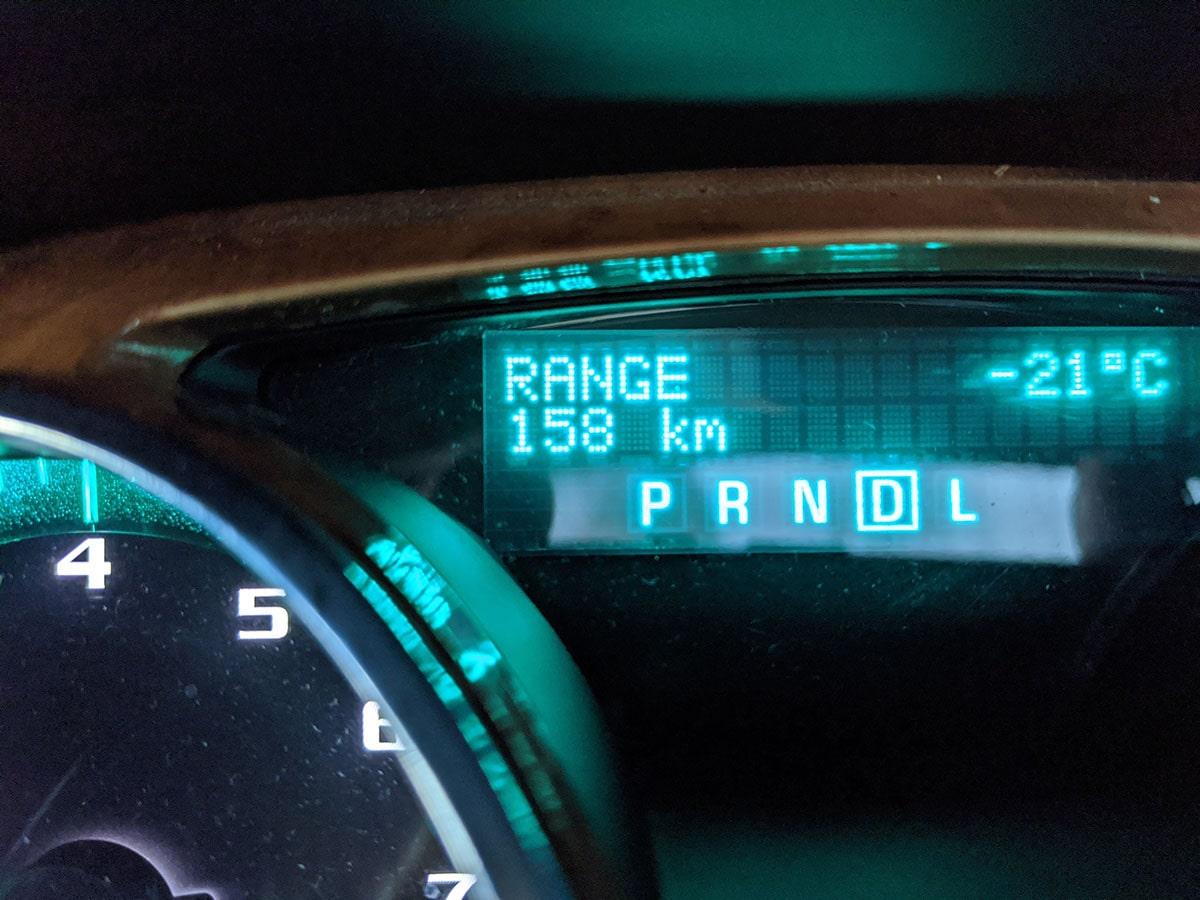
The Quick Answer: Most "no-start" issues in Burlington's extreme cold are caused by reduced battery chemistry, thickened engine oil, or frozen fuel lines. To ensure a start during a February deep freeze, ensure your battery has at least 600–750 Cold Cranking Amps (CCA) and your engine is protected by full synthetic oil, which remains fluid at -30°C.
The Anatomy of a Start: How Your Car Is Supposed to Work
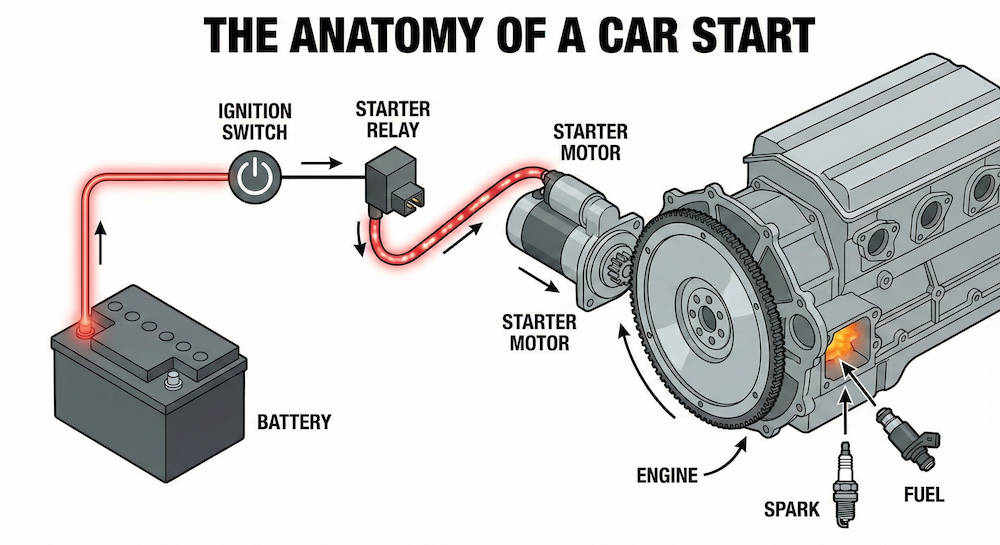
Before we look at what goes wrong in a Burlington blizzard, it's helpful to understand the "chain of command" that happens when you turn your key or press the "Start" button:
- The Signal: Your ignition switch sends a small electrical current to a Starter Relay.
- The Surge: The relay acts as a bridge, allowing a massive burst of electricity to flow from the Battery to the Starter Motor.
- The Engagement: A small gear (the pinion) on the starter motor jumps forward to mesh with the engine's Flywheel.
- The Crank: The starter motor physically spins the engine's internal parts, drawing in air and fuel.
- The Fire: Spark plugs ignite the fuel, the engine takes over, and the starter gear retracts to rest.
Why Your Car Doesn't Start When It's Cold
When the temperature drops to -20°C in the Halton Region, that "Chain of Command" breaks down. The cold creates a "double whammy": it weakens the battery's ability to give power while simultaneously increasing the amount of power the engine needs to turn over.
Quick Diagnostic: Is It the Battery or the Starter?
Use this table to identify the culprit before calling a tow truck:
|
What You Hear/See |
Likely Culprit |
Immediate Action |
|
Rapid clicking sound |
Weak Battery |
Attempt a jump-start; test battery health. |
|
One single loud click |
Starter Motor |
Tap starter (if accessible) or seek repair. |
|
Engine cranks very slowly ("Rrrr-rrrr") |
Cold/Thick Oil |
Use a block heater or switch to synthetic oil. |
|
Engine cranks fast but won't fire |
Fuel or Ignition |
Check fuel level (ensure >1/4 tank); check spark plugs. |
|
Complete silence/No lights |
Dead Battery |
Check for terminal corrosion; ensure car is in "Park" or "Neutral" to permit starter cycle |
How Can I Prevent Cold Start Issues in Winter Weather?
To prevent the issues above, we have to address the two most important components of a winter start: Amps and Oil.
Understanding Cold Cranking Amps (CCA)
CCA is a measurement of a battery's power. It is calculated by measuring how many Amps a 12-volt battery can deliver for 30 seconds at -18°C (0°F) while maintaining a voltage of at least 7.2 volts.
Essentially, it measures the battery's "burst" strength in the exact conditions we face in Ontario.
What is an appropriate CCA for Burlington, ON?
We recommend 600 to 750 CCA for most cars and SUVs.
That's because at -18°C, a battery loses roughly 40-60% of its strength. If your battery is rated for 600 CCA but is old and degraded, it may only be outputting 200 CCA – not enough to break the "stiffness" of a frozen engine.
Synthetic vs. Standard Oil: The Physics of Flow
Standard Oil
Derived from crude oil, it contains wax-like molecules (paraffins). In Burlington's sub-zero temperatures, these molecules crystallize, turning your oil into a "sludge" that resists flow.
Synthetic Oil
Built from the ground up in a lab, synthetic oil is wax-free. Its molecules are uniform and stable. This allows it to stay liquid and circulate to your engine's critical components in seconds—even at -35°C—whereas conventional oil might take minutes to reach the top of the engine.
Block Heaters vs. Battery Blankets: Which Is Better at Preventing Cold Start Issues?
If you don't have a heated garage, these two tools are your best defense against the "No-Start" blues.
|
Feature |
Block Heater |
Battery Blanket |
|
What it is |
A heating element installed into the engine block. |
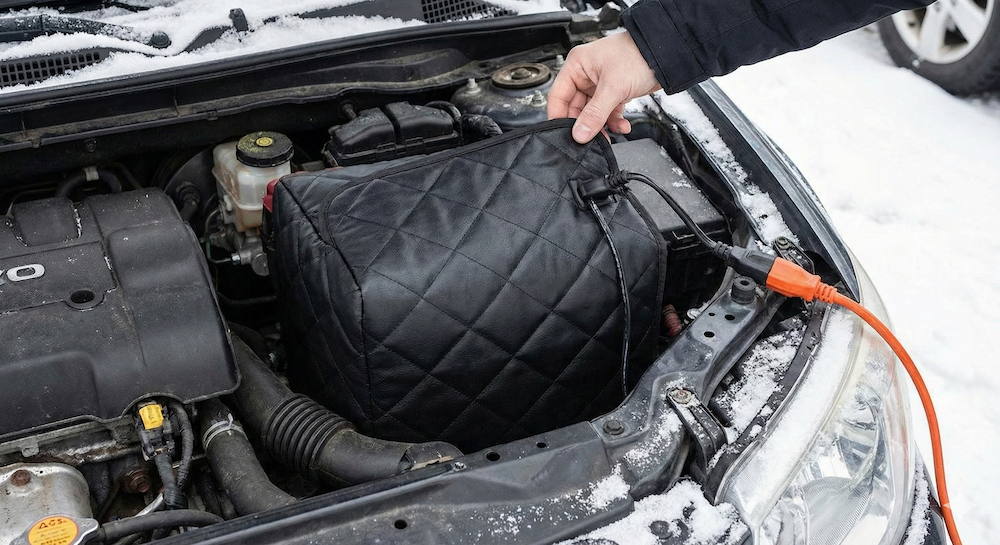
An thermal insulative "wrap" that goes around the battery. |
|
How it works |
Heats the engine coolant or oil directly to reduce drag and friction so the engine cranks easier and starts faster. |
Protects the battery from summer time over heat conditions which protects electrical storage potential. Plug in style battery blanket stabilizes battery temp. |
|
Best For |
Reducing engine wear and getting "instant" cabin heat. |
Ensuring maximum cranking power for old batteries at extreme temp. |
|
When to use |
Use when temps drop below -15°C. |
Use plug in style if your battery is 3+ years old in extreme cold. |
|
Est. Cost |
$150 – $300 (Installed) |
$50 – $120 (DIY or Shop) |
4 Keys to Keeping Your Car Running on the QEW All Winter Long
- The Quarter-Tank Rule: Keep your gas tank at least 1/4 full. This prevents moisture from condensing on the tank walls and freezing in your fuel lines. Any entrained air sucked up by the fuel pump can cause serious engine damage during a cold start.
- Terminal Health: Ensure your battery terminals are free of bluish white, or crusty corrosion. Even a small amount of buildup can block the massive current needed for a cold start.
- The 7-Second Rule: If the car doesn't start, don't crank the engine for more than 7 seconds. This generates extreme heat in the starter motor. Wait 30 seconds between attempts to let the battery recover.
- Use Full Synthetic Oil: Switching to a winter-grade synthetic (like 0W-20 or 5W-30) ensures that oil reaches your top-end components within seconds, preventing catastrophic engine wear during those first few frozen minutes.
Burlington Winter Preventive Maintenance Checklist

Before the next Burlington "Snow Day," check these four items:
- Antifreeze: Ensure your mix is rated for -35°C.
- Wiper Fluid: Use -40°C "De-Icer" fluid (summer fluid will crack your reservoir).
- Tire Pressure: Cold air is denser; your "Low Tire" light will likely trigger as temps drop.
- The "Load Test": Have a professional at The Auto Station perform a load test to see your battery's actual CCA output.
The Auto Station "Safe Start" Guarantee
Don't wait until you're stranded at the Burlington GO station or the remote parking area out behind Mapleview Mall in the arctic blizzard conditions that we've all come to expect in a Burlington winter weather storm. Our team can perform a Winter Health Check, which includes:
- A Digital Battery Health Test to see exactly how many CCAs your battery has left.
- A Full Fluid Analysis and changeover to ensure all your vehicular systems are running smoothly and are cold temp proofed.
- Ensuring ignition systems are locked and loaded for cold weather readiness
- Ensuring the air filter is clean and permits maximum air flow
- Ensuring the fuel delivery system is primed and pumped to handle extreme cold conditions.
If you need a block heater installed or a switch to winter-grade synthetic oil, we're here to keep you moving into spring.
Book your Winter Health Check today and drive with confidence all February long.
