

|
The Long & Short Of It To prepare your vehicle for Ontario's first frost, test your heater and defroster, switch to winter wiper blades and -40°C washer fluid, check and clean every light, and book your winter tire swap. In Burlington, the first autumn frost usually arrives around October 15, so now is the perfect time to get a jump on Old Man Winter. Here's the five-minute version:
|
When does the first frost hit Burlington?
The first autumn frost in Burlington arrives around October 15 on average, according to the City of Burlington. Lake Ontario softens temperature swings near the shore, so frost often shows up first in north Burlington and along the escarpment, farther from the water.
First frost here isn't just about cold. Four local conditions make it harder on your car than the thermometer suggests:
|
Local condition |
What it does to your vehicle |
|---|---|
|
Humid air off Lake Ontario and Hamilton Harbour |
Heavy overnight moisture turns into windshield frost and thin ice on bridges once temperatures touch 0°C |
|
Freeze-thaw swings |
October and November nights dip below freezing while days climb above it, which tests batteries, wipers, and defrosters every morning |
|
Early road salt |
Salt trucks hit the QEW and Highway 403 after the first icy morning, and that salt spray coats lights and glass (how salt affects your car) |
|
Stop-and-go QEW commutes |
Slow, short trips give a weak heater or defroster nowhere to hide |
How do you test your car's heater and defroster?
Do a 15-minute test drive with the heat on full and the vents set to defrost. A healthy system blows hot air within 10 to 15 minutes, the temperature gauge settles in the middle, and the windshield clears from the bottom up without any wiping. Test it now, on a cool October morning, not on the first -10°C day.
The 15-minute heater and defroster test
- Start the car cold, first thing in the morning.
- Drive for 5 minutes, then set the temperature to full hot, the fan to medium, and the vents to defrost.
- Watch the temperature gauge. It should climb to the middle and stay there.
- Cycle through every vent mode and fan speed. Listen for clicking or ticking behind the dashboard.
- Check that the A/C light comes on in defrost mode. Most vehicles run the A/C compressor during defrost to pull moisture out of the air.
- Turn on the rear defroster and look for the grid lines clearing evenly across the back glass.
Warning signs and what they usually point to
|
What you notice |
Common cause |
|---|---|
|
Air is still lukewarm after 15 minutes |
Low coolant or a thermostat stuck open |
|
Temperature gauge stays low on the highway |
Thermostat stuck open |
|
Sweet, syrupy smell inside the car |
Coolant leaking from the heater core |
|
Greasy film on the inside of the windshield |
Heater core leak |
|
Windows fog up and won't clear |
A/C not engaging in defrost, a clogged cabin air filter, or recirculation left on |
|
Clicking behind the dashboard |
Failing blend door actuator |
|
Hot air on one side, cold on the other |
Low coolant or a blend door problem |
|
Rear window lines stay frosted |
Broken defroster grid, blown fuse, or a bad relay |
What you can fix yourself
- Use fresh air, not recirculation, when defrosting. Recirculated air holds the moisture from your breath and wet boots.
- Clean the inside of the windshield. A film of grime gives fog something to cling to.
- Replace a dirty cabin air filter. Check your owner's manual for the interval.
Anything on the warning-sign list needs a technician. At The Auto Station, we check coolant level and freeze protection, test the thermostat, pressure-test for leaks, and confirm the A/C engages during defrost. Since your defroster relies on the A/C system, our car AC repair team handles both.
Should you switch to winter wiper blades?
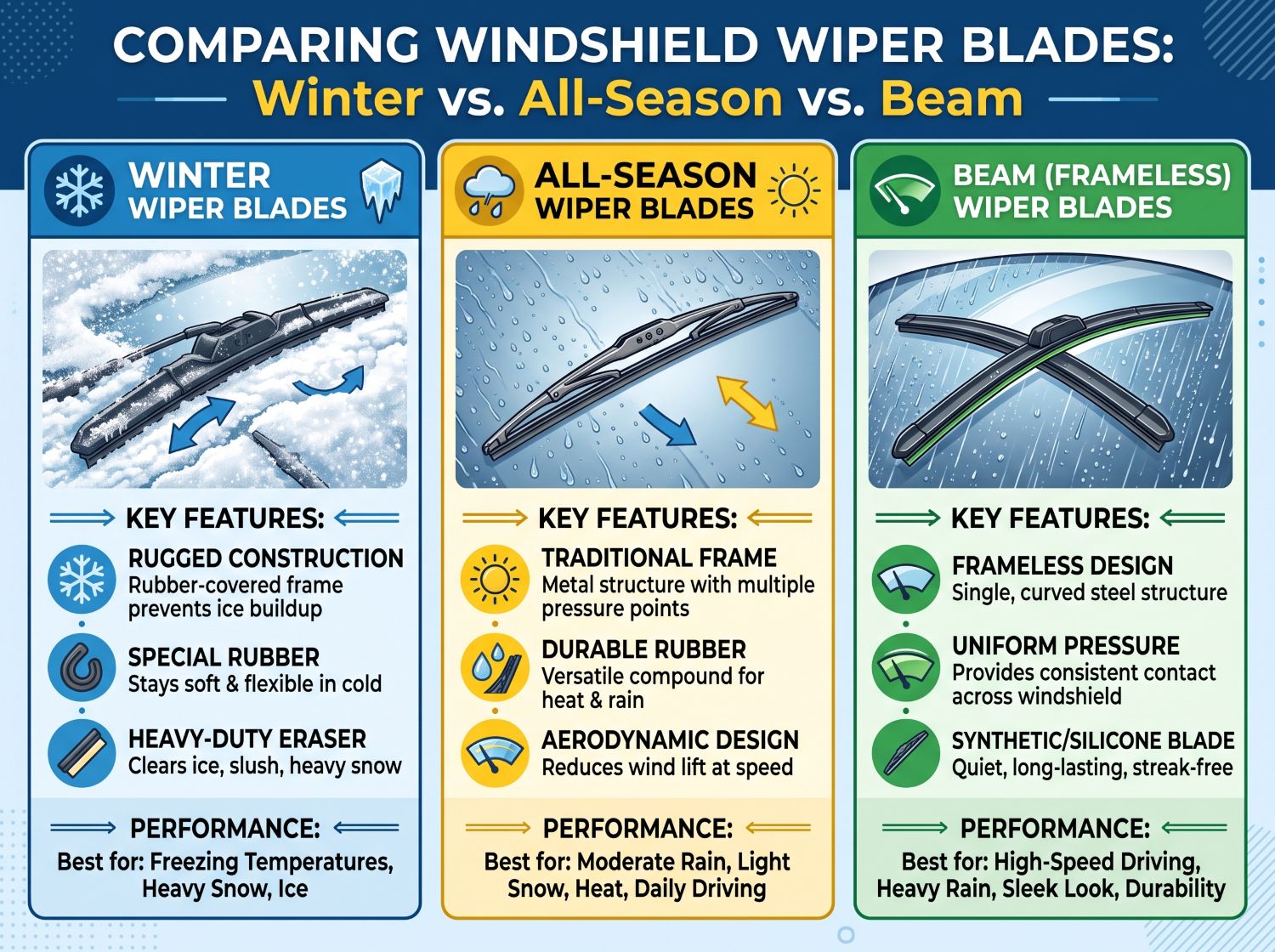
Yes, if you drive every day from November to March. Winter blades are wrapped in a rubber boot that keeps ice and slush from packing into the frame, so the blade stays pressed flat against the glass. All-season blades handle rain well, but their open frames clog with ice and start streaking once the slush arrives.
Winter vs. all-season vs. beam blades
|
Winter blades |
All-season (framed) blades |
Beam blades |
|
|---|---|---|---|
|
Design |
Metal frame sealed inside a rubber boot |
Open metal frame with exposed hinges |
One-piece, frameless spring-steel strip |
|
Ice and slush build-up |
Resists build-up |
Freezes in the hinges and lifts off the glass |
Resists build-up, with no frame to clog |
|
Best for |
Daily winter commuting and freezing rain |
Spring, summer, and fall rain |
Drivers who want one blade year-round |
|
When to use |
Late October to April, then swap back |
April to October |
All year, replaced about once a year |
If your car came with beam blades from the factory, a fresh set is usually all you need for winter. If it has framed blades, winter blades are worth the switch. Switch back in spring, since winter rubber wears quickly on warm, dry glass.
Don't forget the washer fluid
Fill up with washer fluid rated to -40°C. Summer bug-wash fluid can freeze in the reservoir and lines on the first cold night. Run your summer fluid low before topping up, because mixing the two weakens the freeze protection.
Three wiper habits that save your blades
- Scrape first, then wipe. Using your wipers to break up ice tears the rubber edge.
- Lift the blades before freezing rain. This keeps them from freezing to the glass overnight.
- Replace at the first streak. Streaking, chattering, or skipping means the edge is worn.
Clear glass is also the law. Ontario's Highway Traffic Act requires a clear view through your windshield, front side windows, and rear window, and drivers can be fined $85 plus a $25 surcharge for driving without one (Onlia).
Are your lights ready for shorter days?
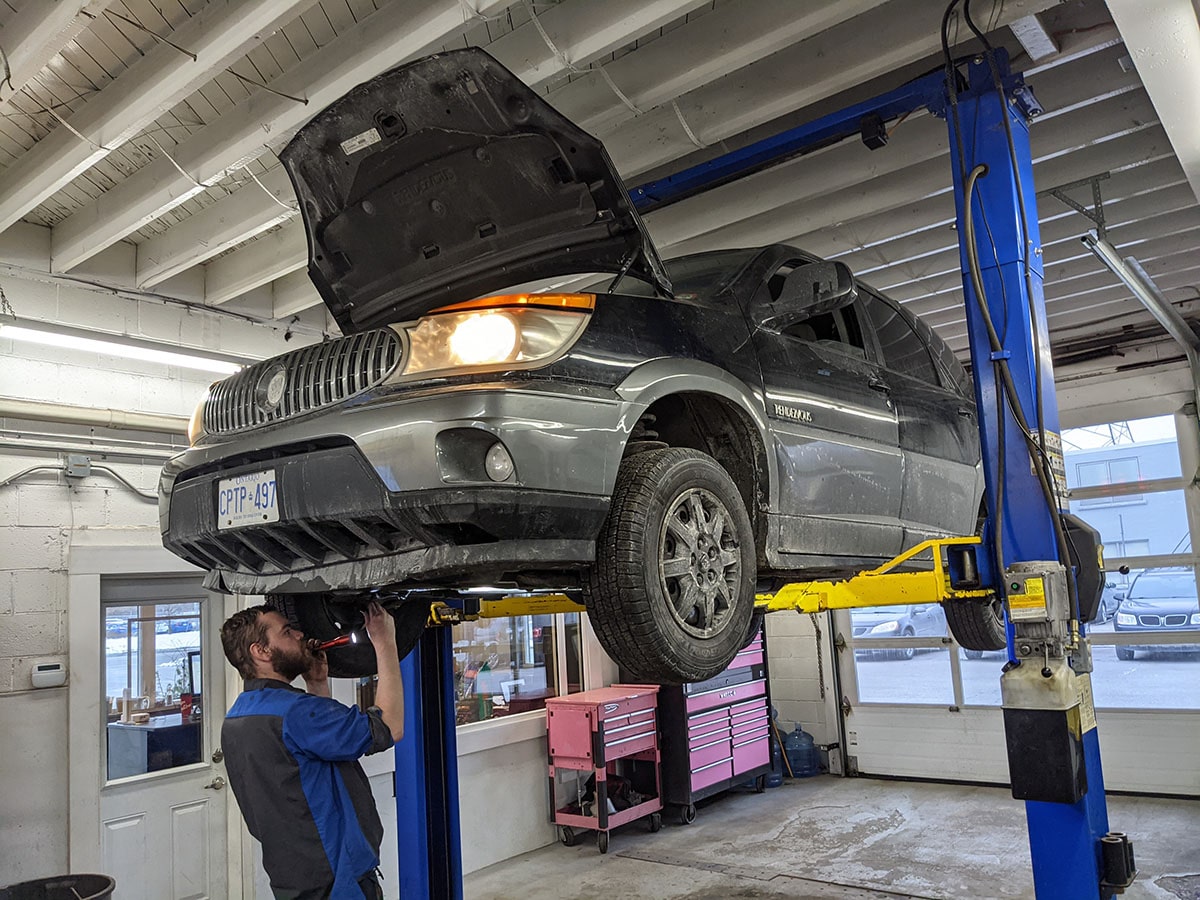
Walk around your car with the lights on and fix anything that's out, dim, or cloudy before November. Burlington loses nearly two hours of evening light in one month: sunset moves from 7:00 p.m. on October 2 to 5:12 p.m. on November 1, the day clocks fall back. By December 21, the sun sets at 4:48 p.m.
What Ontario law requires
Ontario's Highway Traffic Act requires your headlights from half an hour before sunset to half an hour after sunrise. They're also required any time poor light or weather makes people and vehicles hard to see at 150 metres (OTD Legal). On November 2, that means headlights on by about 4:40 p.m., so most of the 5 p.m. QEW commute now counts.
The daytime running light trap
Daytime running lights are not headlights. On many vehicles, they light up the front but leave your tail lights off, while the dashboard glows as if everything is on. Transport Canada has required new vehicles since September 2021 to fix this, but older vehicles still have the problem (Transport Canada). Set your headlight switch to Auto or On and leave it there until spring.
Your 5-minute lighting check
- Every bulb: Low beams, high beams, brake lights, turn signals, reverse lights, and the licence plate light. Ask someone to stand behind the car while you press the brake.
- Cloudy lenses: Yellowed, hazy headlight lenses cut the light reaching the road. Headlight restoration fixes most of them.
- Aim: Headlights pointed too low shorten your view, and pointed too high they blind oncoming drivers. Pothole hits can knock them out of line.
- Salt film: After the first salty commute, wipe your headlights and taillights clean. Salt spray dims them fast.
- Snow cover: Brush snow off every light and your licence plate before you drive, not just the windshield.
How do you drive the Burlington Skyway when there's black ice?
Treat the Skyway as icy any time temperatures are near 0°C, even if the QEW leading up to it is only wet. Slow down before you reach the bridge, keep your steering and braking smooth, and double your following distance. Bridges freeze first, and the Skyway is one of the most exposed bridges in the region.
What is black ice?
Black ice is a thin, clear layer of ice that makes the pavement look wet instead of white. It forms when drizzle, fog, or melted snow freezes on the road surface. Because you can't see it, the first sign is often your car not responding to the steering wheel.
Why the Skyway freezes before the road does
The Skyway runs about 2.2 km across the Burlington Bay Canal, with its deck about 36.7 metres above the water. Cold air moves above and below the deck, so it loses heat much faster than pavement sitting on solid ground. Moist air from Lake Ontario and Hamilton Harbour supplies the water, and the area is foggy enough that the bridge has its own fog lighting system.
Your dashboard thermometer can read a few degrees above zero while the bridge deck is already frozen. The sensor measures air temperature, not road temperature. The same applies to overpasses and ramps across Burlington, including the QEW, 403, and 407 interchange.
How to cross safely
- Check conditions before you leave. Ontario 511 shows road conditions and traffic cameras.
- Slow down before the bridge, not on it. Braking on ice is when skids start.
- Turn off cruise control. You want full control of the throttle.
- Stay in your lane. Avoid lane changes and sudden steering on the deck.
- If you start to slide, ease off the gas and steer where you want to go. With anti-lock brakes, press firmly and steadily. Don't pump the pedal.
Your car matters here too. Winter tires, a clear windshield, and working lights give you the most time to react when traffic stops on the bridge.
What else should you check before the first frost?
Tires, battery, coolant, and an emergency kit round out first-frost prep. Each one is quick to check in October and much harder to deal with on the shoulder of the QEW in January.
|
Check |
Why it matters before first frost |
What to do |
|---|---|---|
|
Winter tires |
The Tire and Rubber Association of Canada recommends winter tires once temperatures drop below 7°C, when all-season rubber starts to stiffen (Co-operators) |
Book your tire swap in early October. Look for the three-peak mountain snowflake symbol, and retire tires with less than 4 mm of tread |
|
Insurance discount |
Every Ontario insurer must offer a winter tire discount on private passenger auto insurance (MyChoice) |
Ask your insurer how much you'll save and what install dates and proof they need |
|
Tire pressure |
Pressure drops as the temperature falls |
Check it monthly, with the tires cold, against the placard in your driver's door jamb |
|
Battery |
At -18°C, a battery loses 40 to 60% of its strength (our winter no-start guide) |
Get a battery load test if yours is more than three years old or cranks slowly |
|
Coolant |
Coolant protects your engine from freezing and feeds your heater |
Have its freeze protection tested, and top up only with the type your manual specifies |
|
Emergency kit |
Skyway closures and QEW pileups can leave you sitting for hours |
Pack a blanket, ice scraper and brush, booster cables, flashlight, phone charger, gloves, and a bag of sand or kitty litter for traction |
Driving an EV or hybrid? Cold weather cuts range and puts more load on the cabin heater, so precondition the cabin while you're still plugged in. Our EV and hybrid maintenance guide covers the rest.
Your Burlington first-frost checklist
Work through this list before October 15, the average first frost date in Burlington.
- Heater blows hot within 10 to 15 minutes of driving
- Defroster clears the windshield, and the A/C engages in defrost mode
- Rear defroster clears the whole back window
- Cabin air filter checked or replaced
- Winter wiper blades or fresh beam blades installed
- Washer fluid rated to -40°C in the reservoir
- Every exterior light working, including brake lights and the plate light
- Headlight lenses clear and aimed correctly
- Headlight switch set to Auto or On
- Winter tire install booked, and your insurer told for the discount
- Tire pressure set to the door-jamb placard
- Battery load-tested
- Coolant freeze protection tested
- Emergency kit in the trunk
- Ice scraper and snow brush in the car
First-frost FAQ
When should I put winter tires on in Burlington?
Put winter tires on once temperatures stay below 7°C, the point where the Tire and Rubber Association of Canada says all-season rubber starts to stiffen. Book your appointment in early October, so the tires can go on as soon as it turns cold, before shops fill up after the first frost.
Is it illegal to drive with a frosted windshield in Ontario?
Yes. Ontario's Highway Traffic Act requires a clear view through the windshield, the front side windows, and the rear window. Driving with frost or snow blocking your view can cost you an $85 fine plus a $25 surcharge. Clear all of the glass, not just a peephole.
Why does my windshield fog up on cold mornings?
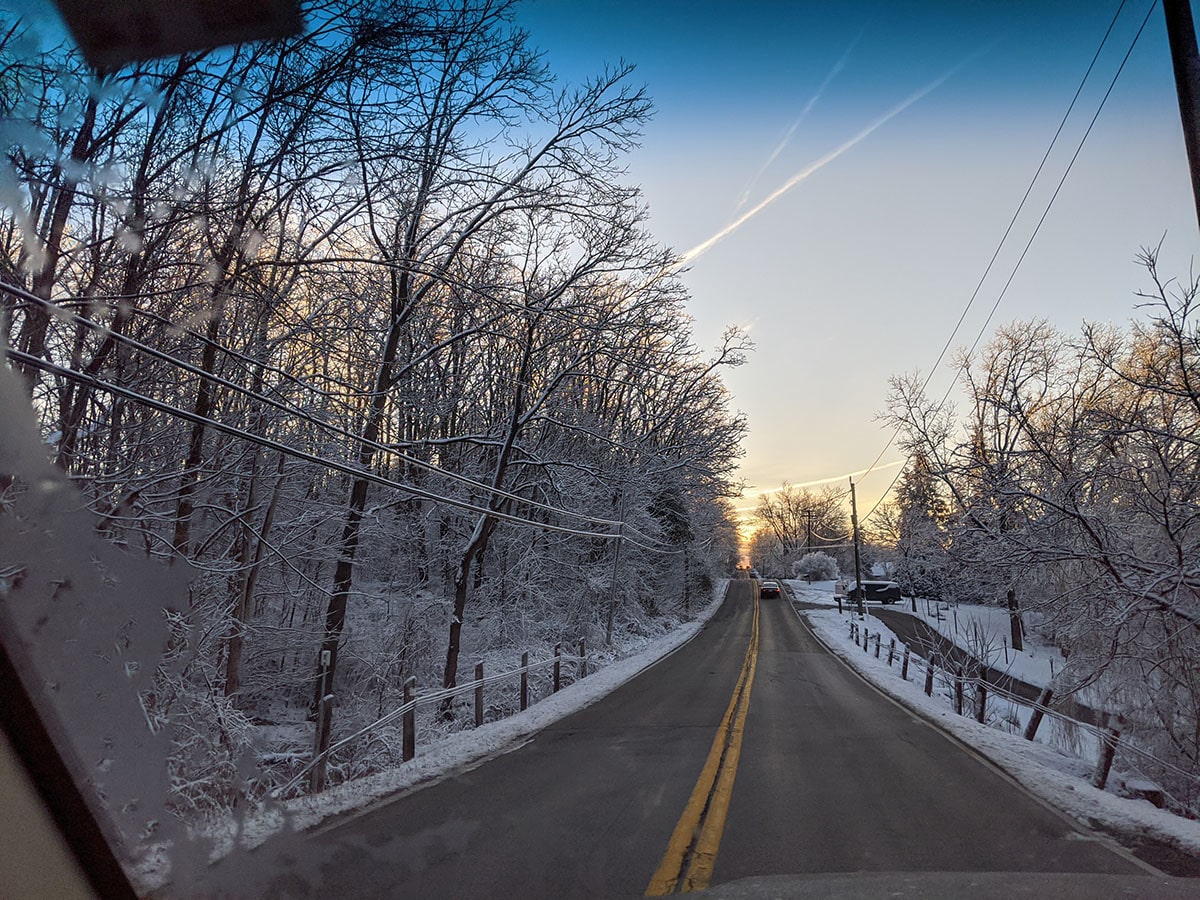
Your windshield fogs when warm, moist air inside the car hits cold glass. Run the defroster on fresh air, not recirculation, and make sure the A/C comes on to dry the air. If the fog keeps coming back, check for a clogged cabin air filter, wet floor mats, or a leaking heater core.
Can I pour hot water on a frozen windshield?
No. Hot water on frozen glass can crack your windshield, especially if it already has a chip. Start the car, run the defroster, and use a plastic scraper. On newer vehicles, a replacement windshield also means recalibrating the driver-assist cameras (2026 Ontario safety laws).
How long should I warm up my car before driving in Burlington?
Most modern engines warm up fastest when you drive gently, not when you idle. Burlington's Parking and Idling By-law 39-2016 also sets a 1-minute idling limit, and unattended idling vehicles can be ticketed on the spot (Ward 2 Councillor). Clear the glass, start the car, and drive off easy.
Are winter tires mandatory in Ontario?
No, winter tires aren't required by law for passenger vehicles in Ontario, but every Ontario insurer must offer a discount when you install them. Look for the three-peak mountain snowflake symbol on the sidewall. Tires marked only M+S may not grip well enough in severe winter conditions.
Get your car frost-ready at The Auto Station
Book a fall inspection before October 15, and we'll handle the whole list in one visit. Routine inspection and maintenance is the best thing you can do for your vehicle's longevity, and first frost is the right time for it. Our technicians test your heater, defroster, and battery, check every light, install winter wipers and -40°C fluid, and get your winter tires on before the November rush.
|
Come See Us at The Auto Station! The Auto Station, 1240 Plains Rd E, Burlington, ON L7S 1W6. Call 289-635-2880, Monday to Friday, 8 a.m. to 5 p.m. |
